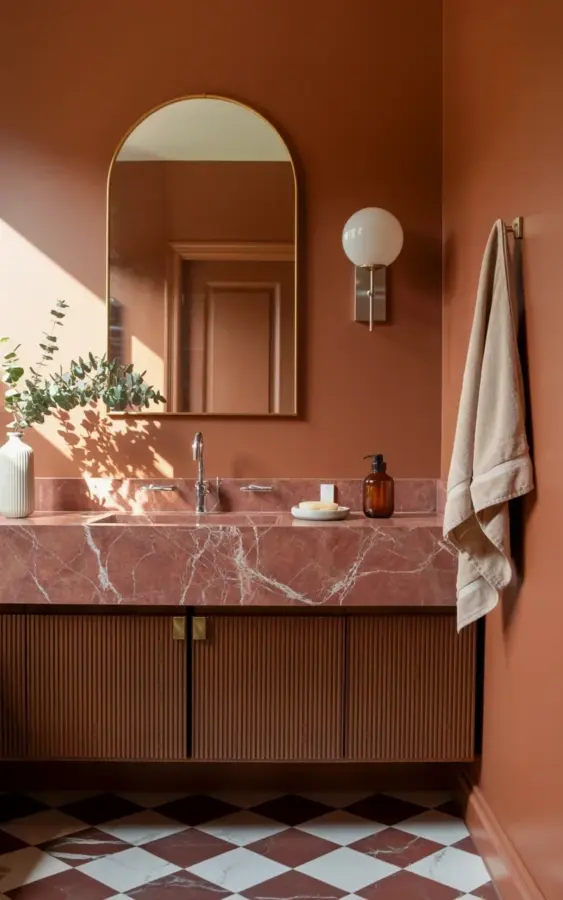
Not gonna lie, I’ve stared at this terracotta bathroom more times than I care to admit. The burgundy and white checkerboard marble tile floor is the first thing that grabs you, and it takes a second to process. But then your eye moves up to the arched brass mirror, and the room suddenly feels less like a showroom and more like a place someone actually lives in. This is a bathroom that knows exactly what it wants: warmth, pattern, and a little bit of old-world charm.
A checkerboard floor doesn’t have to shout
Burgundy and white marble checkerboard is a bold call, no question. Most people see a pattern like that and immediately picture an old Italian bistro or a 1920s hotel lobby. But in this room, the floor never feels overwhelming. Why? Because the walls and the vanity stay quiet, and the floor gets to be the star. The dark wood ribbed paneling on the lower cabinet absorbs a lot of the visual noise. I think that’s the secret: you need at least one calm surface next to a loud one.
The checkered tile floor works especially well because the scale is generous. The squares are big enough to read as a pattern, but not so huge that they make the room feel smaller. If you’re considering a similar floor, pay attention to tile size. Tiny checkerboard tiles can turn a bathroom into a dizzying headache. Go bigger, and let the color contrast do the talking.
How to soften a bold bathroom tile pattern
Once you commit to a patterned floor, you have to think about everything above it. This room uses three counterweights: the arched brass mirror, the wood vanity, and the terracotta walls. Each one does a different job. The mirror adds a soft curve. The wood adds warmth. And the wall color simply disappears into the background, which is exactly what you want when your floor is this busy.
Here are a few materials that soften a bold tile pattern in any bathroom:
– Wood tones. Light oak or dark walnut both work, just pick a grain that doesn’t compete with the marble.
– Textured walls. Limewash or matte paint gives the eye a place to rest.
– Brass or chrome fixtures. Either can look right, but keep the finish consistent with your mirror.
– Soft textiles. A simple beige towel or a linen curtain breaks up all those hard surfaces.
I once painted a bathroom the color of a slightly burnt terracotta pot, and it looked awful with everything I owned. Turns out the trick is letting the wall be the background, not the star. This room gets that balance exactly right.
An arched brass mirror does the heavy lifting
The arched brass mirror is the focal point for me. It’s not a massive statement piece, but the shape softens all the straight lines in the vanity and the tile. Arched mirrors have been trending for a few years, and they’re not going anywhere. The brass frame adds a slight vintage feel, while the ribbed wood cabinet underneath keeps the whole arrangement modern. Honestly, if you swapped this mirror for a plain rectangle, the room would lose half its charm.
What I appreciate most is how the mirror echoes the arch of the sconce globe and the curve of the towel. There’s a subtle repetition happening. It’s not obvious, but your brain notices it. If you’re pairing a bold floor with an arched mirror, think about what else in the room can carry a rounded shape. It doesn’t have to be big. A curved soap dish, a round vessel sink, even a circular rug would all reinforce the same visual language.
Building a marble bathroom around a warm palette
Marble bathrooms usually go in the opposite direction. You see white Carrara, gray veining, chrome fixtures, and it all feels a bit cold. This room takes a different approach. The burgundy and white checkerboard marble floor gives you the classic material, but the terracotta walls and dark wood stop it from becoming an icebox. If you love marble but want a warmer look, choose a marble with colored veining or a pattern that leans into deep tones.
A marble bathroom doesn’t have to be all whites and creams. Colored marble, especially in deep reds or greens, brings a richness that plain white stone just can’t match. And because marble is naturally cool to the touch, pairing it with warm painted walls makes the space feel balanced. I’d step barefoot on that floor in the morning. Not every marble bathroom can say that.
Making terracotta walls work in every season
Terracotta is often called a fall color, but I think that undersells it. In summer, it pairs beautifully with white linens and lots of greenery. In winter, you can lean into the darkness with deeper wood tones and brass. This particular bathroom feels like it was designed for October, but I’d still enjoy it in July. You just need to let the wall color stay in the background and bring in seasonal accents. A eucalyptus branch in a glass vase, a different towel color, maybe a small stack of folded clothes. That’s all it takes.
This is the season-specific thing I keep coming back to: warm earthy bathrooms are having a real moment right now. We’ve spent years staring at all-white, all-gray spaces, and they’re starting to feel sterile. Terracotta brings back a sense of being grounded. It’s not a trend that’s going to age badly, because it’s essentially just the color of clay. And clay has been around for forever.
Small details that make this vanity area feel collected
Look at the towel hanging on the hook to the right. It’s beige, not white, and it fits the palette perfectly. The chrome sconce with the frosted glass globe provides focused task lighting without trying to compete with the mirror. And the floating vanity lets the checkered tile floor continue underneath, which is a clever trick to make the room feel larger. Details like these are easy to overlook, but they’re
Leave a Comment